Origin Story
.....how this work came to be

"Synchronicity is the coming together of inner and outer events in a way that cannot be explained by cause and effect and that is meaningful to the observer."
— C.G. Jung
When I began to dive into my ancestral history for clues about the people whose attitudes, hopes, fears, and DNA fragments I had inherited, I couldn’t have guessed that it would lead me down the path of writing a book. I really just wanted to learn more about my family’s lives, and how their experiences may have shaped me with all my various strengths and flaws.
Up to that point, the only ancestor of note that I knew of was my 4th great-grandfather, Henry Morrissey. An unassuming man of Halifax, Nova Scotia by way of Cork, Ireland, he reportedly fought with Lord Nelson at the Battle of Trafalgar and helped move him from the line of fire after he was felled with what would be his mortal wound. At his death in 1879, he was one of only eight remaining veterans of that war, and the only one on this side of the Atlantic according to a New York Daily Herald obituary. We visited his gravesite on a family vacation to Nova Scotia many years ago.
I secretly hoped to find an interesting story somewhere in my past but did not expect much drama from a family who(as far as I knew) were mostly farmers, factory workers, and accountants. Very run-of-the-mill, normal, everyday folk. But where did the musical interests in our family come from, the origin of my intense sensitivity to the smell of fire, my family’s tendency toward bottling up emotions on one side, and overexpressing them on the other? What drew my eldest toward colleges exclusively in the South (when both his father and I hail from colder climes)?
I didn’t know if I would find answers to all of my questions, but I was motivated to try. I had no idea that I would uncover so many connected threads between the roads that my modern family’s life has taken - unknowingly weaving back and forth across those of our ancestors all these years(more in future posts). As I talk to and read1 books by others doing similar historic and ancestral work, I’ve learned that it is not uncommon for synchronicities to appear in the most unexpected places.
Me? Write?
About this time, early in the COVID pandemic of 2020, a friend asked me to join her one Saturday in a short online creative writing workshop offered by River Heron Review. Judith Lagana, one of the founders of the Review guided our small group through creative prompt-based writing exercises. It was fun! For a newbie writer, the format (Amherst Writers & Artists Method) encouraged me, and the feedback was helpful. I ended up enrolling for three more eight-week sessions. I’d never thought of myself as a writer. The few scientific papers I’d written in grad school, and an occasional Haiku didn’t count as far as I was concerned.
It was during the first session of this course that I discovered stories about my 3rd great-grandmother, Ida Gray. There was scant information in our family documents about her or her husband, Henry Crippen. They appeared with very few details in a family tree I’d done as a class assignment in grade school. I also found a photocopied black and white portrait of her in a photo album I'd inherited from my dad, well after I was deep into her story. She stared back at me with her piercing eyes and a slight smile, wearing a dark dress with white polka dots, a large silk bow at the neck, her hair parted at the center and adorned with a low toque of curled ribbons and feathers over a tight twist at the nape of her neck.
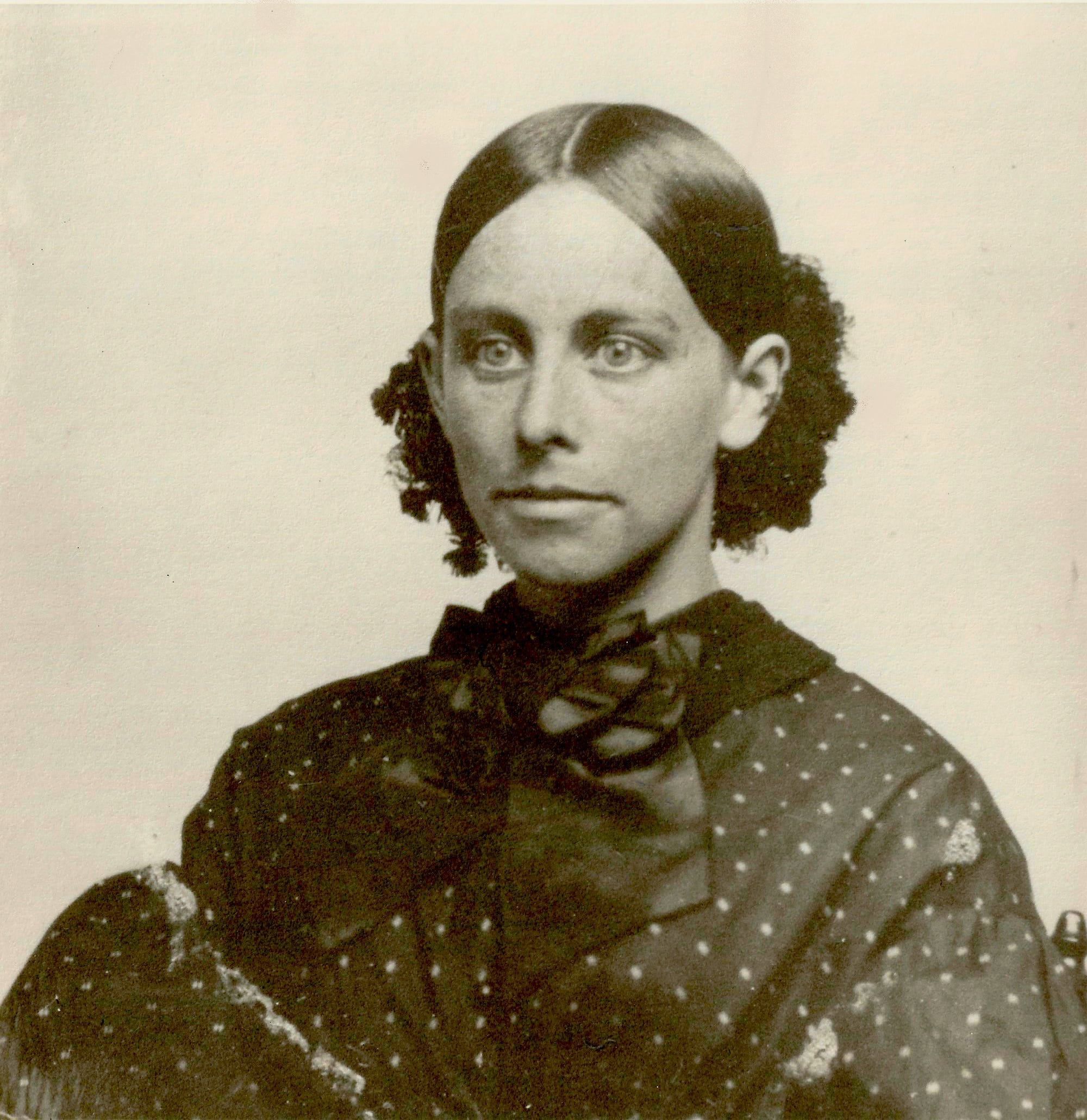
When I exhausted the leads on ancestry search websites, I dug into various newspaper archives and came upon the first nuggets of her story. I found advertisements for variety shows from across the Upper Midwest - Detroit, Chicago, and Buffalo that listed Ida Gray dancing in sketches such as “The Irish Emigrant”, “Scarlet Letter, or The Elfin Child”, and “Born to Good Luck” in the late 1850s. Her good luck would not last, however. I found clippings from all over the country - from Boston to Baltimore to New Orleans, and even from London, with reports of her dramatic end. An article reprinted in The Washington, D.C. National Republican on August 3, 18612, reported in great detail the circumstances of her death.
Accident at Canterbury Hall - An Actress in Flames
“Last night, at Centerbury Hall, an accident, which promised a fatal termination, occurred. The audience were awaiting the performance of a burlesque on Othello, which was nigh ending in real tragedy. The property man had placed a taper in an oblique corner of the stage, shaded from observation by a large harp. The taper was to be used in the burlesque of the last scene of Othello, where it was meant to serve as a comparison to the eyes of the jealous Moor, between the artificial light of itself and the promethean flame in the bosom of the fair Desdemona. The artificial, however, was near extingusing the promethean flame in Madame Molney[a stage name of Ida Gray] - a lady who was to personate the wife of Othello. She, while wandering about the stage, incautiously stood near the properties of the next piece, when her dress immediately caught fire. An affrighted ballet girl raised the alarm and Madame Molney ran in all directions, which increased the flames. The actors followed her with blankets, with the object of wrapping her in them, and after persistent exertions, succeeded. The body was afterwards conveyed to her residence, and this morning she was was pronounced out of danger……The excitement among the audience during the scene was intense. - N.Y. Evening Express, 1st.”
Unfortunately, she was not completely out of danger, as she succumbed later that day from her burns. From the Berkshire County Eagle, Pittsfield, MA(August 8, 1861):
“Principal Danseuse at Canterbury Hall, on Broadway, N.Y., set her gauze dress on fire by the footlights, while dancing last Wednesday night, and died from the burns. Her shrieks were dreadful. Her name was Mrs. Ida Crippen, her age 36 years, and she supported herself and her little daughter by her own exertions, her husband having deserted her to join the rebel army.”
The deserter was her husband Henry Crippen. Her little daughter, Clara Crippen, was my 2nd great-grandmother and the protagonist of the book I am writing. The family bible that was passed down to me has her name printed in gold on the cover.
The lure of New Orleans
It was that last detail that floored me. What kind of man born and bred in Upstate New York would have left to fight alongside the Confederate South to preserve slavery!? He had left very early on in the conflict, sometime between the first shots at Fort Sumpter in April of 1861, and the end of July. It challenged my assumptions about my family, and the over-simplified version of history I’d been taught about the Civil War. Clearly, I had a LOT to learn! (more in future posts)
It turns out that Henry ended up in New Orleans, Louisiana after the war, as did his brother, Frederick, who appears to have run off to San Francisco right after Lincoln’s 1863 draft, to avoid fighting altogether. Only a year after the war began, New Orleans fell to the Union after a mutiny at one of the protectorate Forts near the mouth of the Mississippi3, and a bungled and ineffective river defense against the Union Navy led by Farragut & Butler. At some point, Henry, using various permutations of his name, married a woman he met in New Orleans, named Annie Whittington. They had two children, and he lived the rest of his very short life managing saloons, wine merchants, and groceries throughout the city. (This part of the story is likely another book in itself!).
It just so happens that in his search for a college in a more tropical climate, my oldest son also ended up in New Orleans. Tired of the cold, wet northern winters of Cincinnati - he only applied to colleges in the South, and Tulane made him the best offer. While there, he met a woman there from Mobile, Alabama(they were married last October) and they’ve lived in New Orleans for the past ten years. Henry’s businesses, homes, and the cemetery where Annie Whittington is buried are all within a two-mile radius of where my son lives now. These were the first coincidences of many that would emerge as I continued my research.
But what about Clara?
So what happened to Ida’s young daughter? She had been living with Henry’s parents and sisters in Utica, NY per the 1860 Federal census. Presumably, Ida and Henry had left her there while they settled in the New York City, intending to send for her later. With her mother’s death, and Henry’s desertion, she was effectively an orphan, beholden to her extended family for support. Her story is one of survival through much early tragedy and loss, through a period of unprecedented change in our country - the social changes of emancipation, the temperance movement, suffrage movement, and the 19th amendment; technological changes - the industrial revolution, invention of the automobile, electric lighting, and the telephone; and economic upheavals including several economic depressions in the late 1800’s up through the Great Depression of the thirties. Much of what I will share here are some of the side discoveries along the way that relate to the synchronicities I have found and stories from my research journey. I hope that you will find it as interesting as I do!
Two good examples:
East West Street by Philippe Sands; about the men who legally defined the terms ‘Genocide’ and ‘Crimes Against Humanity’ after WWII, interwoven with personal family stories connected to that work; and
The Love Songs of W.E.B. DuBois by Honorée Fanonne Jeffers, tracing a family’s roots back to the original inhabitants of this country, and the violence and love that shaped it over generations.
https://chroniclingamerica.loc.gov/lccn/sn82014760/1861-08-03/ed-1/seq-3/
Mutiny at Fort Jackson: The Untold Story of the Fall of New Orleans, by Michael D. Pierson, 2008, University of N. Carolina Press.
This is absolutely one of the many reasons for anyone to learn about family history: “It challenged my assumptions about my family, and the over-simplified version of history I’d been taught about the Civil War.” Thanks for sharing.
This is such a fascinating story! I'm inspired to share more of my own story of genealogical discovery, and excited to read more of yours as it unfolds.