By George
Bye George

As I write my great-great grandmother’s life story a number of mysteries have popped up. The stickiest one so far is that of her eldest son, George Theodore Schulze. His date of death is unknown - I’ve only seen it listed as “after 1944" - and for most of his life, his exact whereabouts are somewhat murky. In a newspaper announcement of my great-great-grandparents’ 50th wedding Anniversary, George is reported to be “in Europe”. (The Boston Globe, Tue. 15 Nov. 1927, p.7)
What I learned about George early on in my research:
George worked in the bicycle trade In Utica, NY - a new craze booming during the 1890s. He was 16, living on his own with some other lads near the Utica Bicycle Academy just down the street from his parents, Clara & Theo. He was also a bike racer - taking part in at least one 24-hour bike race in 1895 and then disappearing from any US records from 1896 - 1913.
In 1913, he married a woman from Hull, England named Florence Knott. She was the second youngest of six daughters born into a grocer’s family. On April 24, they George & Florence traveled back to the United States together, on the steamship Arabic of the White Star Dominion Line, from Liverpool to Halifax with 1966 others. George listed his occupation as “Engineer”. Their stated intent was to emigrate to Canada. Initially, they resided in Somerville, MA not far from his parents and siblings, and he secured a job as a chauffeur - mechanical skills being a requirement for the job in those early days of automobile travel!(https://commonwealthchauffeur.wordpress.com/2013/02/14/the-history-of-the-chauffeur/ )
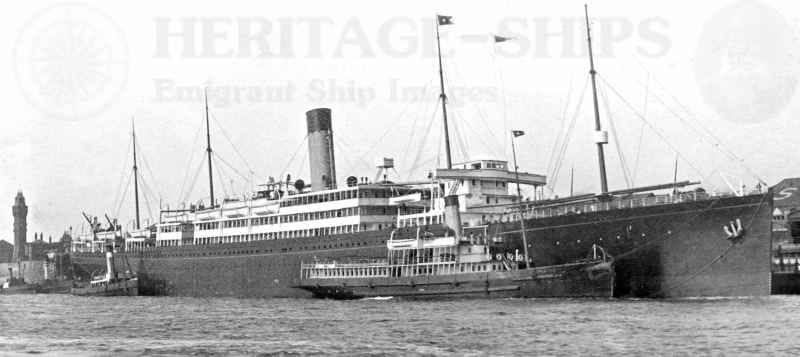
Arabic(2) at Liverpool (image credit: Norway Heritage - Hands Across the Sea , www.norwayheritage.com)
In January 1914, Florence’s mother and younger sister, Anne and Winifred, came to the US on the Cunard Line ship, Caronia, from Liverpool to Boston in 2nd Class with the intent to live in the United States. (Aside: The Caronia was the first ship to warn the Titanic of “bergs, growlers, and field ice” on that fateful night). They’d followed Florence and George’s lead, fearing an imminent British entry into the war (which occurred Aug. 4, 1914), and avoided several Zeppelin bombing raids of Hull in 1915 - 16. In December Florence gave birth to a girl whom they named Winifred Claire.
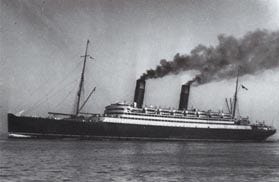
Caronia at Sea (image credit: Wikipedia, https://en.wikipedia.org/wiki/RMS_Caronia_(1904))
By 1920 Florence, her daughter Winifred (who went by her middle name Claire), her sister, Winifred, and her husband George MacIssac, were living in Buffalo, NY boarding with Richard & Bertha Morris and their two children. Florence was working as a “sorter” in a laundry. George was also listed at the same address as a “soldier” in the US Army, and Winifred’s husband was a painter.
With this background, I developed a plot line, assuming they had been in Buffalo for a few years, in which George became fixated on joining the Army as he ferried young men in his taxi from the train depot in Buffalo to the first United States Reserve Officers Training Corps (ROTC) Camp at Fort Niagara. Some of these young men from wealthy families were described to “know more about the different brands of face powder than they do about gunpowder” by some local papers. (Training the Doughboys - New York State Parks Blog) The garrison, built by the French in 1679, had been very active in the early years of colonization, as the British, French, and Americans defended borders and land. I thought it was plausible that he wished to return with the American Expeditionary Forces to defend Florence’s home country - one that he had also grown to love. It may have also been a way for him to thumb his nose at his father’s German heritage. My hunch is that they did not get along.
AND THEN! Not more than a month after I had written the first draft of that section, a woman from Western Australia reached out to me on Ancestry. She had gotten DNA tests back, and found we were a fairly close genetic match - second or third cousins - yet we had no connected family that either of us could see. I replied to her inquiry, telling her about the mystery surrounding George, that he had married a woman from Hull, England, so perhaps we had some common links through that.
To my astonishment, she replied that my great-granduncle George was her grandfather! Her mother had uncovered his WWI service records that revealed his true identity. They were easily accessible to me via the excellent online Canadian Military records.1
In August 1918 he enlisted with the Canadian Expeditionary Forces(CEF) at Camp Petewawa in Ontario, under the alias of George Charles May. He was nearly 40 years old at the time(but listed his age as 38 yr. 11 mo.), stood 5’ 6 1/2” tall(we do run short in my family!), and had light brown hair, blue eyes, and flat feet(as did my father). He gave his father’s name as Henry(deceased), listed prior military service with the 3rd Imperial Dragoon Guards of the British Military, and his residence as 227 West Grand Blvd., Detroit, Michigan. As to religion, he checked the “Church of England”. Was “Henry”, his supposed father a nod to his grandfather who abandoned Clara to fight in the South? Or was he a real person? His father’s address was listed as 33 Beverly Road, Hull England.
After very reluctantly instituting a draft in 1917, Canada continued to have difficulty raising the troops needed for the final push of the War - expected to come in 1919. In early 1917, it was taking four months of recruitment to replace one month’s losses. Of the eligible men, almost 94% immediately applied for an exception to the draft - the initial enthusiasm for serving fading with the realization of the brutality and costs of life experienced on the battlefield during the first three years.*2 I would guess that there was not much probing into the veracity of his claims or identity.
George then traveled with the CEF to Great Britain and was deployed as a truck driver during the war. My Australian cousin kindly sent me a picture of him driving a Canadian Red Cross lorry. My family had no pictures of him to my knowledge.
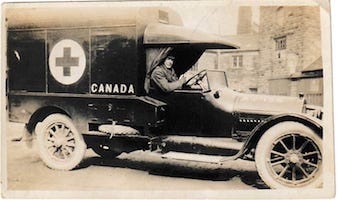
George Theodore Schulze (aka George Charles May) C.E.F ca. 1918 - 1919. (photo credit: Gloria Stilling)
While George was in England (still legally married to Florence) he married another woman who was with child. It is clear that this “George Charles May” was indeed “George Theodore Schulze” as in his service records, the name of his second wife is crossed out, and his birth name and Florence’s name and address are entered. The Canadian military forced his second wife to return the money she had been given which were his earnings from service so that they could be given to Florence! The stories of these women will be featured in other posts.
I love a good family history mystery, and this one, though not a primary storyline keeps me intrigued. For Clara, the estrangement of her eldest son must have been a source of sorrow as she strived for a close-knit family after so many early experiences of loss.
So many questions still remain! What was he doing in England from 1896 - 1913? Did he actually return to England to fight with the Third Dragoons or did he assume the identity of someone that had served there? Why was he in Detroit in 1918? Did he ever return to Buffalo? (I believe he did for a time). When did he die, and where, and how?
What questions does this raise for you? Let me know in the comments!
Chris Sharpe "Enlistment in the Canadian Expeditionary Force 1914-1918." Canadian Military History 24, 1 (2015) (https://scholars.wlu.ca/cgi/viewcontent.cgi?referer=&httpsredir=1&article=1753&context=cmh)
So interesting to read of George's earlier life and to learn much more detail than I thought I could ever learn about him.